
花磚物語:花園宮殿
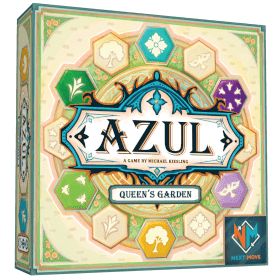 歡迎回到辛特拉王宮!曼努埃爾一世國王委託葡萄牙最優秀的花園設計師,為他的妻子阿拉貢的瑪麗亞王后建造最非凡的花園。
在《花磚物語:花園宮殿》中,玩家需要透過佈置美麗的植物、樹木和裝飾元素,為國王的愛妻打造一座宏偉的花園。
運用花磚系列標誌性的創新輪抽機制,玩家必須精心挑選色彩繽紛的花磚來裝飾花園。只有最出色的花園設計師才能脫穎而出,贏得女王的恩典。
玩家人數: 2 - 4
遊戲歷時: 28 mn
複雜度 3 / 5
在線上玩 花磚物語:花園宮殿 以及 1415 款其他遊戲。
無需下載──直接用你的網路瀏覽器玩。
與你的朋友以及全世界成千上萬的玩家們。
免費。


在線上玩 花磚物語:花園宮殿 以及 1415 款其他遊戲。
無需下載──直接用你的網路瀏覽器玩。
與你的朋友以及全世界成千上萬的玩家們。
免費。
規則摘要
Objective
Arrange the most beautiful garden and have the most victory points at the end of 4 rounds.
Gameplay
This game is played in 4 rounds. Each round is played in 3 phases:
- Phase 1: Players perform actions of acquiring tiles and placing them in their garden
- Phase 2: Scoring
- Phase 3: Preparation for next round (not performed in the 4th round)
Phase 1: Actions
A player can store 12 tiles and 2 garden expansions at any given time. If the player does not have enough room to acquire all applicable tiles, the player cannot take that action.
During the action phase, choose 1 of the following:
- Take a tile or tiles of the same color or same pattern (but not both).
- Place a tile to create or add to a group.
- Select a tile from your storage. Pay its cost, then place the tile on your garden board. If any fountain, statue, bench, or pavilion is surrounded, you earn a joker hexagon (if there is a space).
- A group is formed when at least two hexagons of identical patterns or identical colors (not both) are adjacent. One hexagon can be part of one group for its pattern and part of another group for its color.
- Place a garden expansion
- Take a face-down garden expansion at the cost of 6 VP
- Pass
- The first player to pass loses 1 VP and cannot take any more actions for the round.
When all players have passed, the round ends and the garden is scored.
What Happens When I Take a Tile?
The tiles are placed on face-down garden expansions. When you take a tile, the garden expansion is moved off the stack, along with the remaining tiles on it.
When a garden expansion has no more tiles on it, it is turned face up (to reveal a feature in its center and a pattern on one of its hexagons) and becomes available to take.
How Do I Pay a Tile's Cost?
The cost of a hexagon is the same as its value, which is displayed in the upper right corner of your garden board (e.g. tree = 1, bird = 2, butterflies = 3, etc.) To pay, you must discard a set of hexagons of the same color but different patterns or different colors but the same pattern as the tile you are paying for. The number of tiles in the set is one less than the value of the tile you're paying for.
For example, if you were placing a blue flower (value of 5), you would have to discard either 4 blue tiles that don't have a flower pattern or 4 flower tiles that are not blue. What you cannot discard is another blue flower tile. If you are placing a tree, you don't have to discard any tiles.
You can also use the gray joker tiles, which are wild in pattern and color.
What Are the Rules for Placing a Tile?
You can either place a tile that's not adjacent to any other tiles (this starts a new group) or adjacent to one or more hexagons that match at least one of the adjacent hexagons (either in color or pattern).
- A player may pass if they no longer wish to perform actions or if there are no legal actions to take.
- When passing, the player may choose to discard any number of tiles from their storage and deducting the same number of victory points.
Phase 2: Scoring
In the play area, the rotary wheel indicates the 3 scored patterns or colors for the round. For each hexagon in your garden matching the pattern or the color indicated by the wheel, you score a number of points. The same hexagon can be scored twice (for its pattern and for its color). Then each player scores 1 point for each visible pavilion in their garden.
Phase 3: Preparation
The wheel rotates clockwise to the next position. All remaining tiles from the face down garden expansions are discarded and the round stack is reshuffled and replaced with 4 random tiles. The new first player places the first player marker in the display area.
End Game
The game ends after four rounds.
- Add 1 VP for each remaining Joker
- Subtract VP for each remaining tile in storage according to its value (tree = -1, bird = -2, etc.)
- Then each group is evaluated according to the evaluation track (to the left of the rotary wheel). For each step, any group of at least 3 hexagons scores per hexagon matching the current evaluation. For example, a group of four blue hexagons (1 tree, 1 bird, 1 flower, 1 bells) would score 14 (1 + 2 + 5 + 6). There is no limit to the number of groups a player may score for the same evaluation. A group is scored by calculating the points for each single hexagon, in function of their
pattern (see the values on the right side of the scoring board)
- You get 6 bonus points for a group of 6