
Perikles
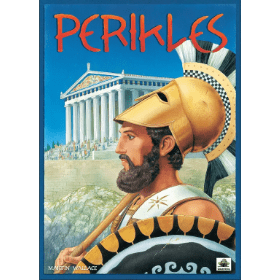 Perikles是Martin Wallace設計的一款遊戲。 玩家扮演一個貴族家族,試圖成為6個古希臘城邦中的一個或多個的領導者。 遊戲分為兩個階段進行:
在第一階段,玩家們在六個城邦中爭奪區域控制權,最終以選舉作結。在每個城邦中贏得選舉的玩家,便可控制該城邦的軍隊。
在第二階段,玩家使用卡牌調動軍隊,攻擊或防守該回合可供爭奪的七場戰鬥中的一場(每場都與一個城邦相關,且你不能攻打自己的城邦!)。
遊戲機制簡潔明瞭,借鑒了其他歐式戰棋的元素(特別是 Martin Wallace 的《帝國爭霸》)。讓《Perikles》獨樹一幟的,是其將區域控制/投票階段與軍事階段流暢地融為一體。
玩家人數: 3 - 5
遊戲歷時: 17 mn
複雜度 4 / 5
在線上玩 Perikles 以及 1394 款其他遊戲。
無需下載──直接用你的網路瀏覽器玩。
與你的朋友以及全世界成千上萬的玩家們。
免費。


在線上玩 Perikles 以及 1394 款其他遊戲。
無需下載──直接用你的網路瀏覽器玩。
與你的朋友以及全世界成千上萬的玩家們。
免費。
規則摘要
Perikles
In Perikles, players represent influential Greek families. Over three epochs, they strive to gain political control in six city-states and lead the armies of these cities to victory in various battles.
Game Objective
Win by accumulating the most Victory Points (VP). Points are awarded at the end of each epoch for won battles (Statue tokens) and at the end of the game for controlling city-states.
Game Flow
The game is played over three epochs. Each epoch consists of two main phases: the Political Phase and the War Phase.
1. Political Phase (Influence & Control)
During this phase, players place their influence cubes to take leadership of the cities.
- Selecting Influence Tiles: Players take turns picking tiles that indicate which cities they can place cubes in.
- Placing Cubes: Cubes are placed in the six cities (Athens, Sparta, etc.).
- Elections: In each city, the player with the most cubes is checked.
- The player with the most cubes becomes the Leader of the city for that round.
- They receive the city's two Army Tiles (Land and Sea forces).
- Specific tie-breaking rules apply if necessary.
- Ostraka (Exile): Players can attempt to remove opposing cubes from cities to secure a majority.
2. War Phase (Battles & Strategy)
The leaders of the cities now deploy their armies to launch attacks against Persia or other Greek locations on the board.
- Deploying Armies: Players place their Army Tiles face-down on available locations. Battles are categorized as Land or Sea combat.
- Resolving Battles: Tiles are revealed. Combat is resolved by comparing combat strength (Strength values on tiles + a die roll).
- Attacker vs. Defender: The attacker must overcome the location's defense or the opposing armies present.
- Casualties: Defeated units are removed from the board.
- Rewards: The winner of a battle receives a Statue token, which provides VP at the end of the epoch.
Actions & Decision Factors
Influence Tile Categories
Tiles offer various tactical options:
- City Symbols: Allow placing 1 or 2 cubes in the corresponding city.
- Event Tiles:
- Plague: Reduces the number of cubes in a chosen city for all players.
- Treachery: Allows weakening or manipulating an army in battle.
- Persian Fleet: Can be used in sea battles to influence the outcome.
Military Units
- Hoplites (Land): Used for land battles in the regions.
- Triremes (Sea): Used for naval battles to secure control over the seas.
- Sparta Special Rule: Spartan land units are exceptionally strong in combat but have less political flexibility.
End of Game & Scoring
Final scoring takes place after the third epoch:
- Statue Points: Sum of points from all three epochs.
- City Control: Players holding leadership in a city at the end of the third epoch receive bonus VP based on the city's value.
- Remaining Influence: Minor points for leftover resources.
The player with the most total Victory Points is the winner.