
Under the Leaves
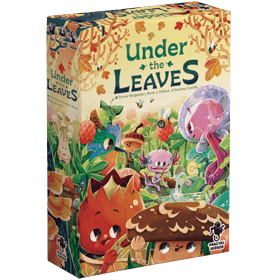 如果我們能夠維持花園的健康與多樣性,它就會充滿生機,成為迷人生物的庇護所。蜂鳥和蜜蜂最先到來,用色彩與動感填滿空氣;但如果我們停下來更仔細地觀察,會發現一個隱秘而未知的世界:微小的居民在蘑菇、水窪和樹葉間繁衍生息。它們就在我們腳下,過著自己的生活,不被察覺……直到我們決定去看葉片之下。
在《Under the Leaves》中,每個回合分為兩個階段進行:放置花園板塊,然後是可能的新生命抵達。誰獲得的居民標記總數最多,誰就獲勝。
玩家人數: 2 - 4
遊戲歷時: 12 mn
複雜度 2 / 5
在線上玩 Under the Leaves 以及 1376 款其他遊戲。
無需下載──直接用你的網路瀏覽器玩。
與你的朋友以及全世界成千上萬的玩家們。
免費。


在線上玩 Under the Leaves 以及 1376 款其他遊戲。
無需下載──直接用你的網路瀏覽器玩。
與你的朋友以及全世界成千上萬的玩家們。
免費。
規則摘要
Game Play
Each turn is played in 2 phases: the placement of a garden tile and then the possible arrival of new beings.
Phase 1: Placing a garden tile
Choose one of the 3 tiles available in the market and place it in your gaming area, next to a tile you have already placed. Once the tile has been placed, you cannot move it. To place a tile, you must position it so that at least one side of it is completely adjacent to another tile that was placed earlier. It is not required that the terrain spaces match in color or that the puddles are adjacent. You can place the tiles in any position so long as you follow the rules for their placement.
Phase 2: Possible arrival of new beings
After placing the tile in your garden, you must check whether any creature is attracted to the garden. It is recommended that you check each kind of being in the following order: bees, hummingbirds, and then the dwellers of the leaves, dwellers of the puddles, and, finally, the dwellers of the mushrooms.
Bees
Bees will come to any recently created sector that has 3 or more continuous terrain spaces that are the same color. This sector will then be called a pollinized sector
1 . Take a bee piece and place it anywhere in the pollinized sector
2 . Then, check whether you already have one or more pollinized sectors of that same color in your garden. If you do, then place a bee piece in each pollinized sector of that color
3 . The pollinized sectors do not have any limit on the number of bees they can hold.
Hummingbirds
When all the terrain spaces of a tile are part of pollinized sectors, that tile attracts a hummingbird. (Remember that puddles are not terrain.) Place a hummingbird piece in the nest in the center of the tile.
In addition, any time you make a row of 3 tiles that have attracted at least one hummingbird, the tile in the middle will attract another hummingbird. Likewise, if you are able to form a column of 3 tiles have attracted at least one hummingbird, the tile in the middle will attract another hummingbird. So, this means that a maximum of 3 hummingbirds can be achieved on a single tile.
Garden Dwellers
So long as your garden grows, there are chances to attract some new inhabitant. To do this, you must check the conditions for each dweller on their respective cards. If you fulfill the criteria indicated, take the piece for the corresponding dweller and place it on the terrain space in question.
There are some general rules that apply to all dwellers: Each combination of terrains can fulfil the criteria only one time, except if the dweller’s card specifically states otherwise. A terrain space may have different types of dwellers.
End of Turn
Once you have added all the creatures attracted by your garden, you must restore the tile market with a tile from the bag. Your turn ends and the game passes on the next player moving clockwise around the table.
End of the Game
The game comes to an end when the tiles in the bag run out and the market cannot be restored. Each player will have played 12 rounds, during which they will have created a garden made up of 13 tiles. Once the game is over, you proceed to count up the final score. Each player that has a majority of any of the dwellers, takes 2 dweller pieces of that type and adds them to their garden. If there is a tie for the majority, the bonus is applied to all the people who tied.
Then, each player counts up all the creature pieces in their garden, taking into account bees, hummingbirds, and the various dwellers. Whoever gets the most pieces in total wins the game. If there is a tie, then the person with the most hummingbirds wins. If there is still a tie, then whoever has the most bees wins. If the tie persists after the bees, then the victory is shared between the tied players.